
Pengaruh Intensitas Pemanfaatan Informasi Spasial dalam Game Online terhadap Perilaku Keruangan Mahasiswa
Article Sidebar
Main Article Content
Abstract
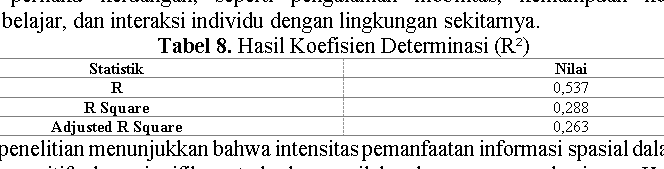
Perkembangan game online telah menghadirkan lingkungan virtual yang kaya akan informasi spasial dan berpotensi memengaruhi perilaku keruangan penggunanya. Penelitian ini bertujuan untuk menganalisis pengaruh intensitas pemanfaatan informasi spasial dalam game online terhadap perilaku keruangan mahasiswa. Penelitian menggunakan pendekatan kuantitatif dengan metode survei. Sampel penelitian berjumlah 30 mahasiswa yang ditentukan menggunakan teknik purposive sampling. Pengumpulan data dilakukan melalui angket, sedangkan analisis data menggunakan statistik deskriptif dan regresi linear sederhana. Hasil penelitian menunjukkan bahwa intensitas pemanfaatan informasi spasial dalam game online berpengaruh positif dan signifikan terhadap perilaku keruangan mahasiswa dengan nilai signifikansi sebesar 0,002 (p < 0,05). Koefisien determinasi (R²) sebesar 0,288 menunjukkan bahwa intensitas pemanfaatan informasi spasial dalam game online memberikan kontribusi sebesar 28,8% terhadap perilaku keruangan mahasiswa. Temuan ini menunjukkan bahwa lingkungan virtual dalam game online tidak hanya berfungsi sebagai media hiburan, tetapi juga dapat menjadi sumber pengalaman spasial yang berkontribusi terhadap pembentukan perilaku keruangan mahasiswa.
Downloads
Article Details
Section

This work is licensed under a Creative Commons Attribution 4.0 International License.
References
Armondi, S., & Pessina, G. (2026). Critical Spatial Thinking and Extreme Events. Tools for Multiple Disciplines. POLIMI SPRINGERBRIEFS.
Bomfim, L., & Cruz, S. S. (2023). Understanding Spatial Cognition for Designing Pedestrian Wayfinding Systems: Development of practical guidance.
Castellar, S. M. V., & Jordão, B. G. F. (2021). Spatial thinking in cartography teaching for schoolchildren. International Journal of Cartography, 7(3), 304-316.
Castellar, S. M. V., Pereira, C. M. R. B., & Guimarães, R. B. (2021). For a powerful Geography in the brazilian national curriculum. In Geographical reasoning and learning: perspectives on curriculum and cartography from South America (pp. 15-31). Cham: Springer International Publishing.
Cauffman, S., Cohen, M. C., Yin, X., Demir Federico Scholcover, M., Huang, L., & Cooke, N. (2022, September). “I Am Here”: Investigating the Relationship Between Sense ofDirection and Communication of Spatial Information. In Proceedings of the Human Factors and Ergonomics Society Annual Meeting (Vol. 66, No. 1, pp. 2021-2025). Sage CA: Los Angeles, CA: SAGE Publications.
de Miguel González, R., & Rivero Gracia, P. (2025). Geospatial Technologies for Heritage Education. In Geospatial Technologies for Heritage Education (pp. 1-8). Cham: Springer Nature Switzerland.
Dwirahayu, G., Satriawati, G., Sobiruddin, D., Prianta, B. A., & Harnum, T. S. (2025). Mapping the Mind: Exploring Students' Visual-Spatial Thinking in Transformation Geometry. Journal of General Education and Humanities, 4(2), 535-548.
Freytag, T., Lauen, D. L., & Robertson, S. L. (Eds.). (2022). Space, place and educational settings (Vol. 55). Bern: Springer Nature.
Haris, H., Mannan, A., & Rasjusti, N. I. (2025). Improving Spatial Thinking Skills through GEE- Integrated STEM Learning: A Quasi-Experimental Study among Geography Undergraduates. Information Technology Education Journal, 507-518.
Hickman, J. (2023). Spatial thinking and GIS: developing and assessing student competencies. International Research in Geographical and Environmental Education, 32(2), 140-158.
Jamshidi, S., Ensafi, M., & Pati, D. (2020). Wayfinding in interior environments: An integrative review. Frontiers in Psychology, 11, 549628.
Jo, I., & Hong-Dwyer, J. J. (2024). GIS learning and college students’ acquisition and understanding of spatial concepts. Journal of Geography in Higher Education, 48(5), 763-774.
Johnson, E. T., & McNeal, K. S. (2022). Student perspectives of the spatial thinking components embedded in a topographic map activity using an augmented-reality sandbox. Journal of Geoscience Education, 70(1), 13-24.
Keil, J., Edler, D., Schmitt, T., & Dickmann, F. (2021). Creating immersive virtual environments based on open geospatial data and game engines. KN-Journal of Cartography and Geographic Information, 71(1), 53-65.
Kolvoord, R. A. (2021). Fostering spatial thinking skills for future citizens to support sustainable development. Cultures of Science, 4(1), 17-24.
Mingon, M., Gillett, A. J., & Sutton, J. (2026). Being Where? Putting Memory, Technology, and Wayfinding Together Again. Review of Philosophy and Psychology, 1-27.
Morawski, M., & Budke, A. (2025). What Is a Map in Digital Games? Expanding Cartographic Literacy Through Ludic Spatial Interfaces in Geography Education. KN-Journal of Cartography and Geographic Information, 1-13.
Pastel, S., Bürger, D., Chen, C. H., Petri, K., & Witte, K. (2022). Comparison of spatial orientation skill between real and virtual environment. Virtual Reality, 26(1), 91-104.
Qiao, X., Tian, S., Tang, M., He, S., Wang, J., Fan, L., ... & Liu, X. (2026). Analysis of Spatiotemporal Features in a Virtual Navigation Game Across Different Age Groups: Quantitative Research. JMIR Serious Games, 14(1), e83128.
Sheahan, J., Davies, H., & Hjorth, L. (2021, July). The Art of Tacit Learning in Serious Location-Based Games. In Frontiers in Education (Vol. 6, p. 686633). Frontiers Media SA.
Silaban, H., Istiawati, N. F., Wijaya, N. M., & Miswar, D. (2026). The influence of geospatial technology-based learning media on students’ spatial thinking ability. Journal Learning Geography, 7(1), 44-56.
Smith, A. D., Priestnall, G., & Cross, J. (2022). Supporting spatial orientation during route following through dynamic maps with off-screen landmark persistence. Spatial Cognition & Computation, 22(1-2), 107-134.
Sugiyono. (2022). Metode penelitian kuantitatif, kualitatif, dan R&D. Alfabeta.
Von Reumont, F., & Budke, A. (2021, August). Spatial thinking with comics in geography education. In Frontiers in Education (Vol. 6, p. 702738). Frontiers Media SA.
White, H., & Forbes, C. T. (2023). An investigation of undergraduate students’ spatial thinking about groundwater. Journal of Geography in Higher Education, 47(1), 128-148.
Wickramasinghe, Y. S., Lukosch, H. K., Everett, J., & Lukosch, S. (2025). Evaluating Spatial Decision- Making and Player Experience in a Remote Multiplayer Augmented Reality Hide-and-Seek Game. Multimodal Technologies and Interaction, 9(8), 79.
Xie, S., Zheng, X., Sun, Y., Wan, J., & Lu, X. (2021). The factors and mechanisms that influence geospatial thinking: a structural equation modeling approach. Journal of Geography, 120(5), 165-175.
Yesiltepe, D., Velasco, P. F., Coutrot, A., Torun, A. O., Wiener, J. M., Holscher, C., ... & Spiers, H. J. (2023). Entropy and a sub-group of geometric measures of paths predict the navigability of an environment. Cognition, 236, 105443.
Zhang, Y., Zhang, B., Jang, W., & Pan, Y. (2024). Enhancing spatial cognition in online virtual museum environments: integrating game-based navigation strategies for improved user experience. Applied Sciences, 14(10), 4163.